Wednesday: 10/8
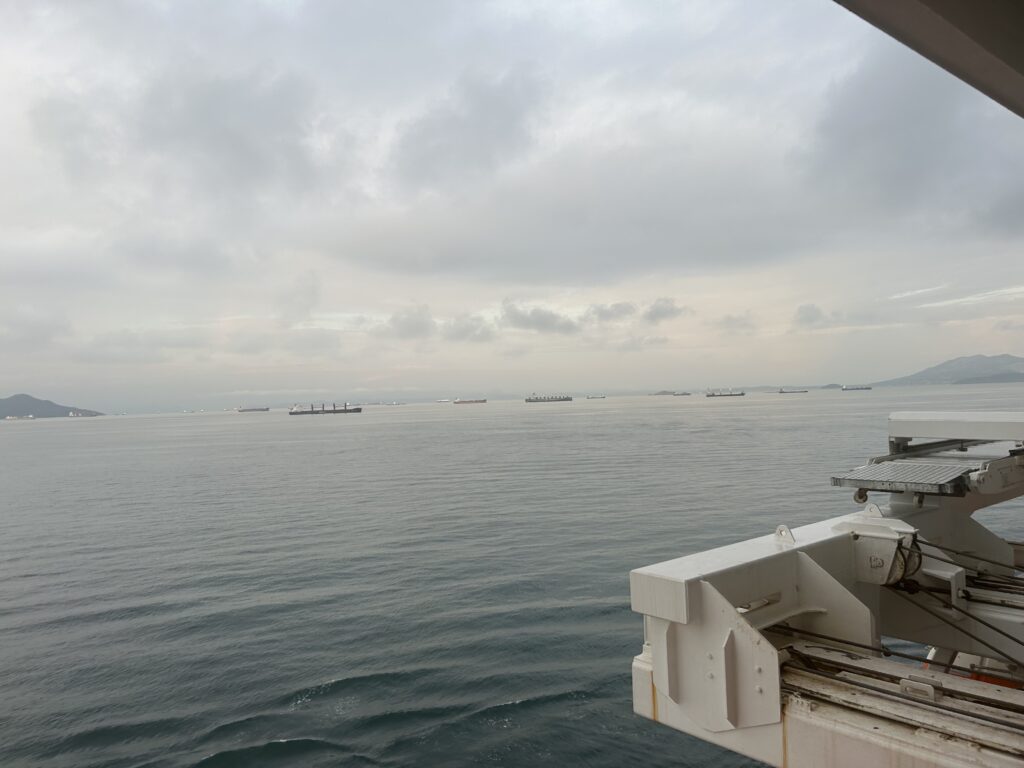
Today we continue our route southeast along the coastlines of Costa Rica and then Panama. We will travel about 505 nautical miles, and the course will take us around Isla de Coiba and Punta Morro de Puercos in the Peninsula de Azuero. We are close to shore, only 25 nautical miles.
Prior to construction of the Panama Canal, ships traveling between the Atlantic and Pacific Oceans had to sail around Cape Horn—a route known for its violent storms and dangerous seas. The journey was long, costly, and often deadly. The dread of cutting through the narrow Isthmus of Panama promised a faster and safer passage. The French first attempted to build the canal in the 1880s but failed due to disease and difficult terrain. The project was handed over to the United States in 1904 which introduced advanced engineering and effective disease control. After years of massive excavation and the creation of a lock system to lift ships across the land, the Panama Canal opened in 1914 stretching 82 kilometers across the country. Ships are lifted through locks on each side, using Gatun Lake, an artificial body of swater created to reduce the amount of excavation work required for the canal, 85 feet above sea level, and then lower the ships at the other end. Today more that 13,000 ships pass through the canal each year, carrying nearly 5% of global trade the Panama Canal remains a symbol of human ingenuity.
Today was a busy morning. After breakfast was Chairobics and Trivia. Between them I went to the lecture on “Theodore Roosevelt, the Panama Canal” given by Thomas Duryea. He gave a history starting with Balboa who imagined a route through the isthmus to transfer silver from the Pacific coast to the Caribbean without having to go around Cape Horn. The French made strides but as we know it was Roosevelt who got it done. One of the main problems was the initial effort to create a sea level passage rather than a lock/lake passage with was finally accepted. Overcoming disease, poor working and living conditions, and crumbling soil were major hurtles.
After trivia was another lecture entitles: “So Far, So Near: The US, Mexico, and Central America by Chase Untermeyer. This focused on the changing relationships of the US to these countries and of the US’ interference and whom or what it benefits. Untermeyer is a former ambassador to Qatar; he served time the Navy during Viet-Nam; other positions include reporting for the Houston Chronicle, national and state politics, Compaq, finally as a professor of public policy at the University of Texas Health Science Center.
Tonight’s show was by Peter Cutler, “The Rhythm of Life.” His show includes songs, piano, comedy, and tap dance.