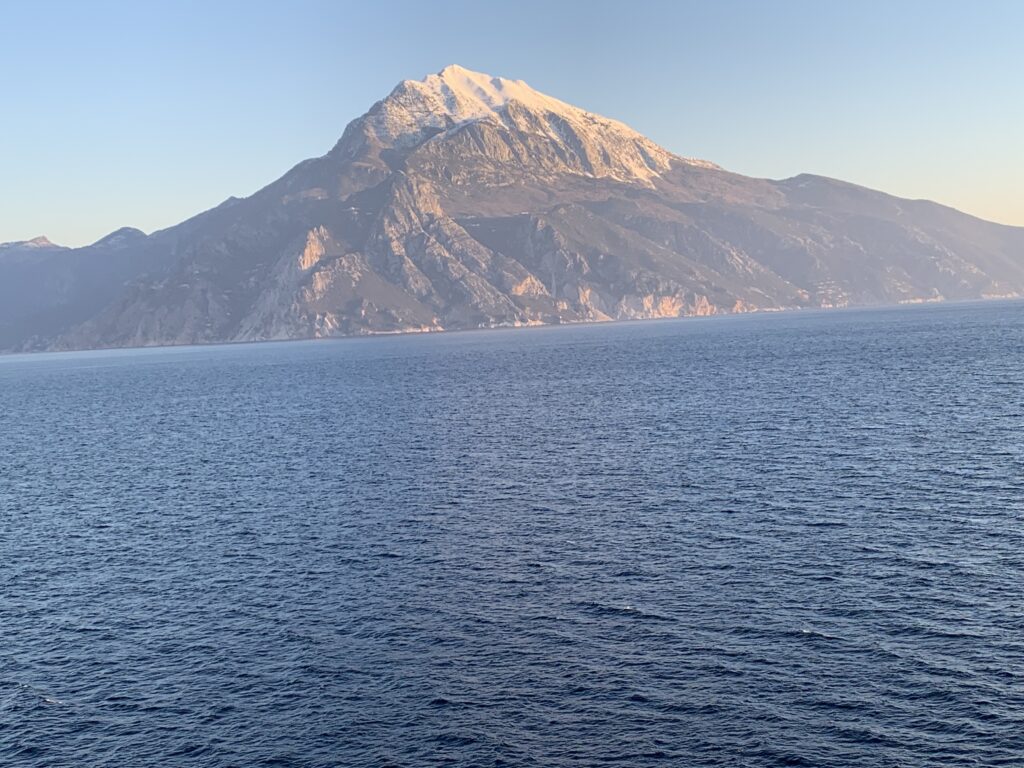
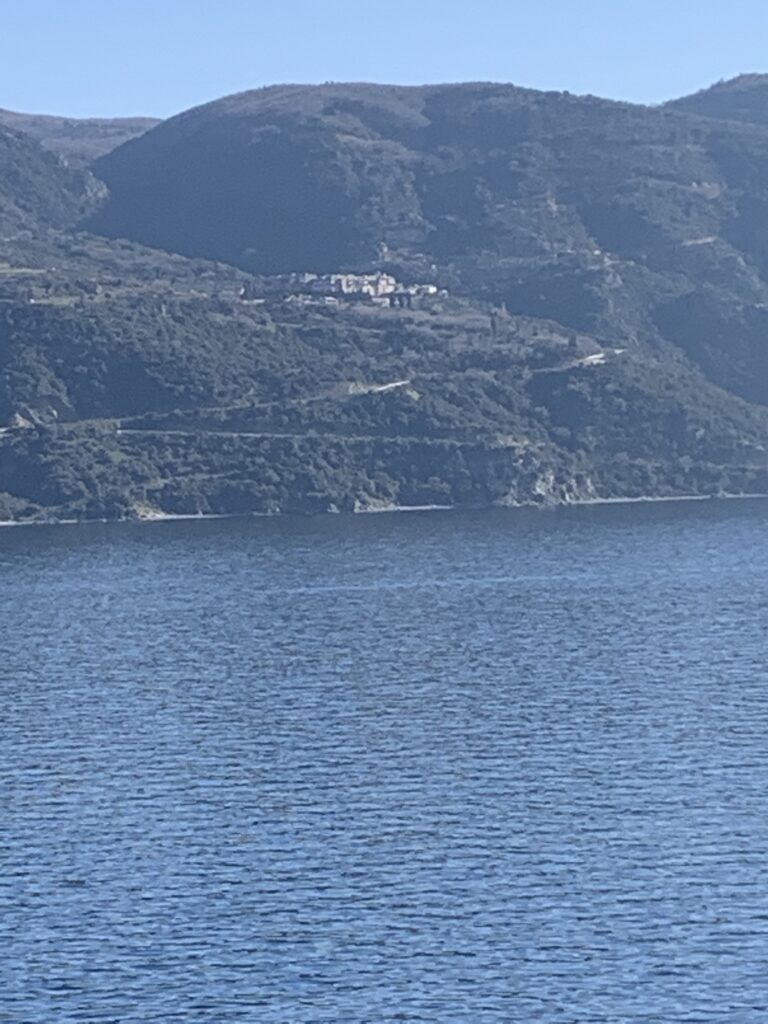
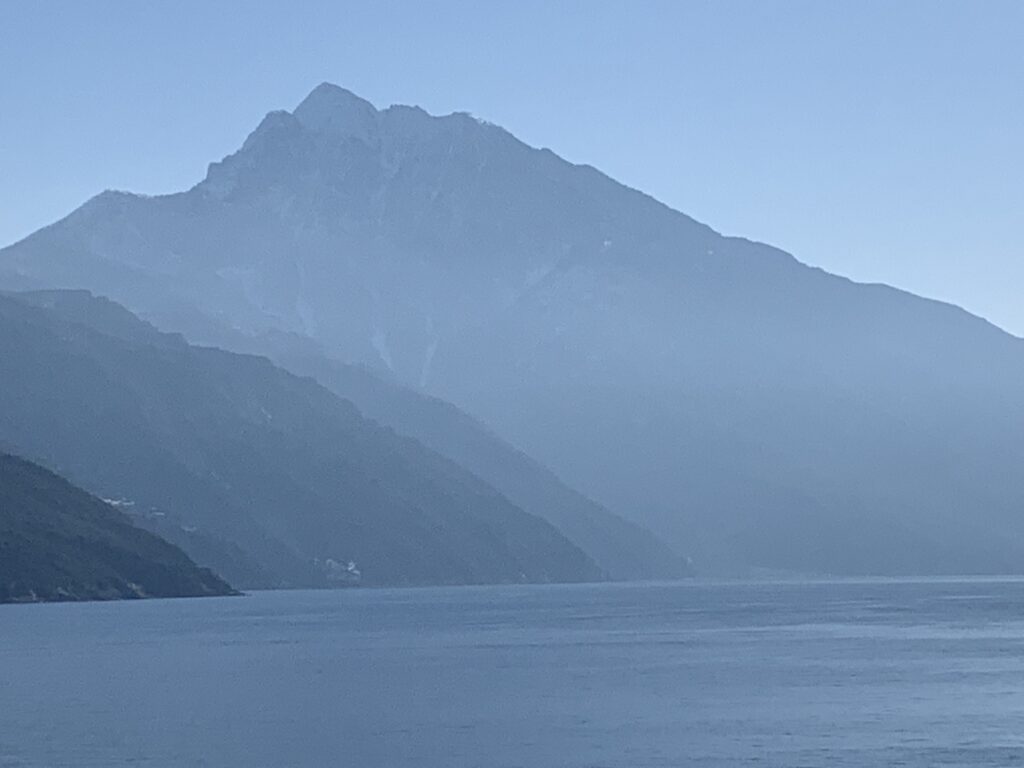
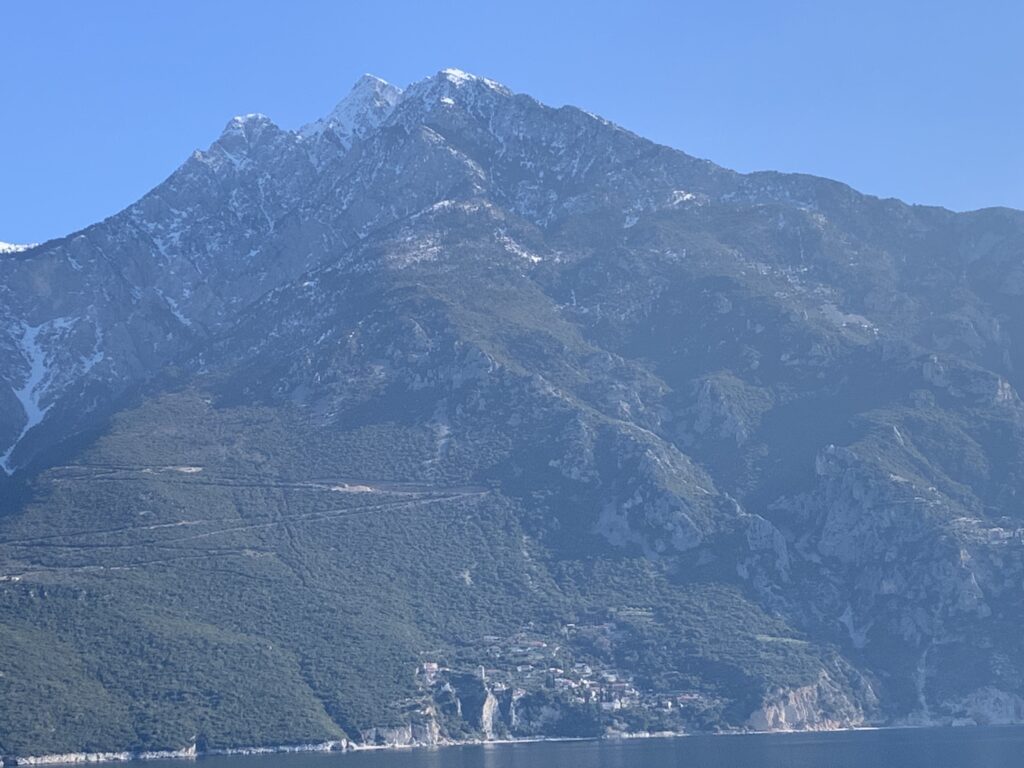
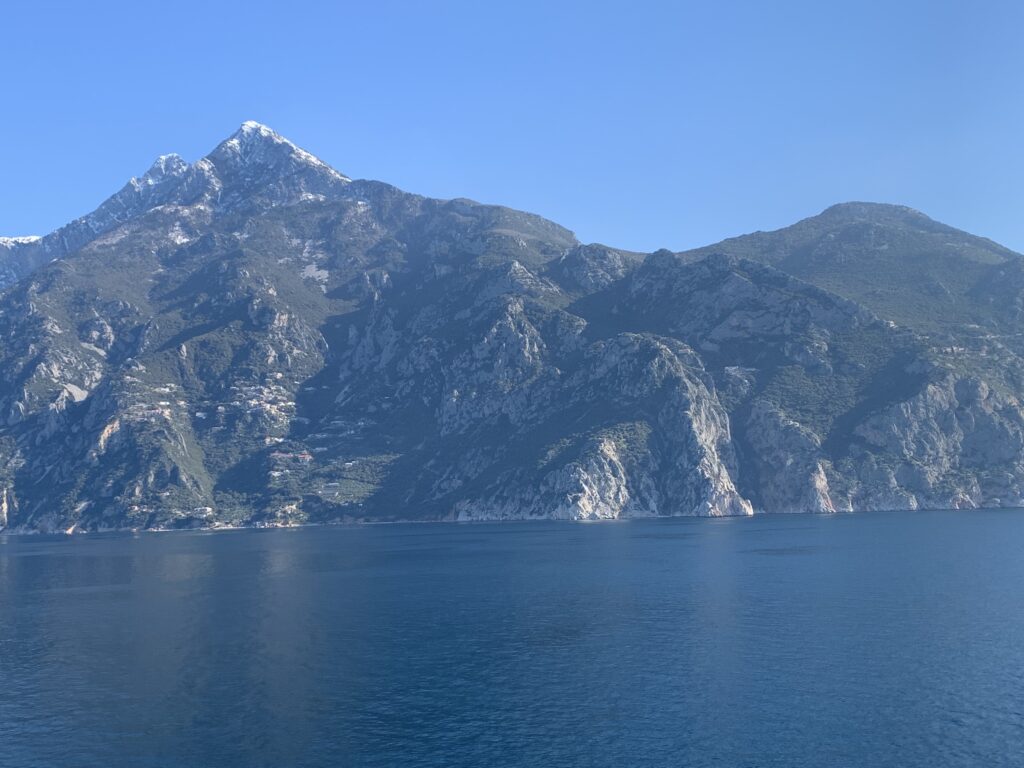
Today was a peaceful day, starting out with time spent circling Mount Athos. Mount Athos is a mountain and peninsula in northeastern Greece and an important center of Eastern Orthodox monasticism. Monks have lived here from at least 800 CE. Today over 2,000 monks from Greece and other countries live an ascetic life in Athos, isolated from the rest of the world. The monasteries are rich repositories of manuscripts and artwork seldom seen by outsiders. Daily visitors to Mount Athos are restricted to 100 lay Orthodox and 10 non-Orthodox pilgrims, and all are required to obtain a special entrance permit valid for three days. Only men are permitted to visit. Females are forbidden, including domestic animals. The Virgin Mary alone represents her sex on Mount Athos, which is dedicated to her glory. I remember years ago that my brother made a pilgrimage there, which had a significant impact on his life. We sat in the Explorers Lounge at the forward of the ship on the 7th level. The view was spectacular. As we watched the UNESCO World Heritage Site, we read about its history and present use. It is amazing to think of the hundreds of monks who have lived on the island for their whole life. The spiritual nature of the island even pervaded the ship as we circled it. After we left Mt. Athos, we headed to Ephesus. Some pictures of Mount Athos follow.
Ephesus Turkey
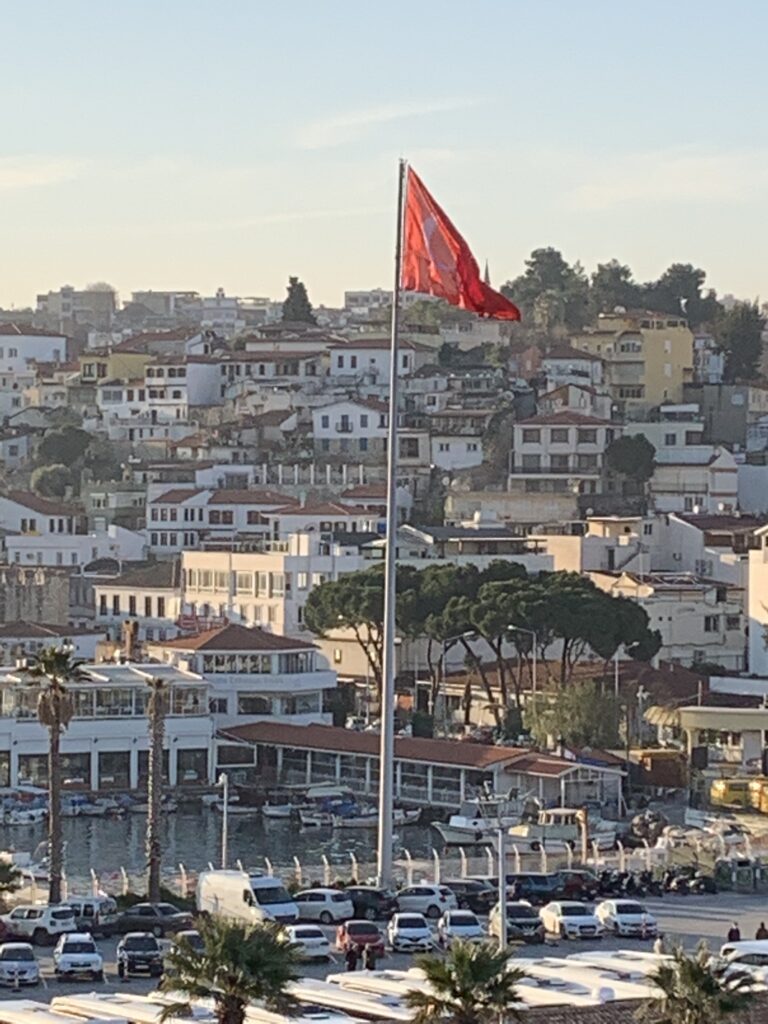
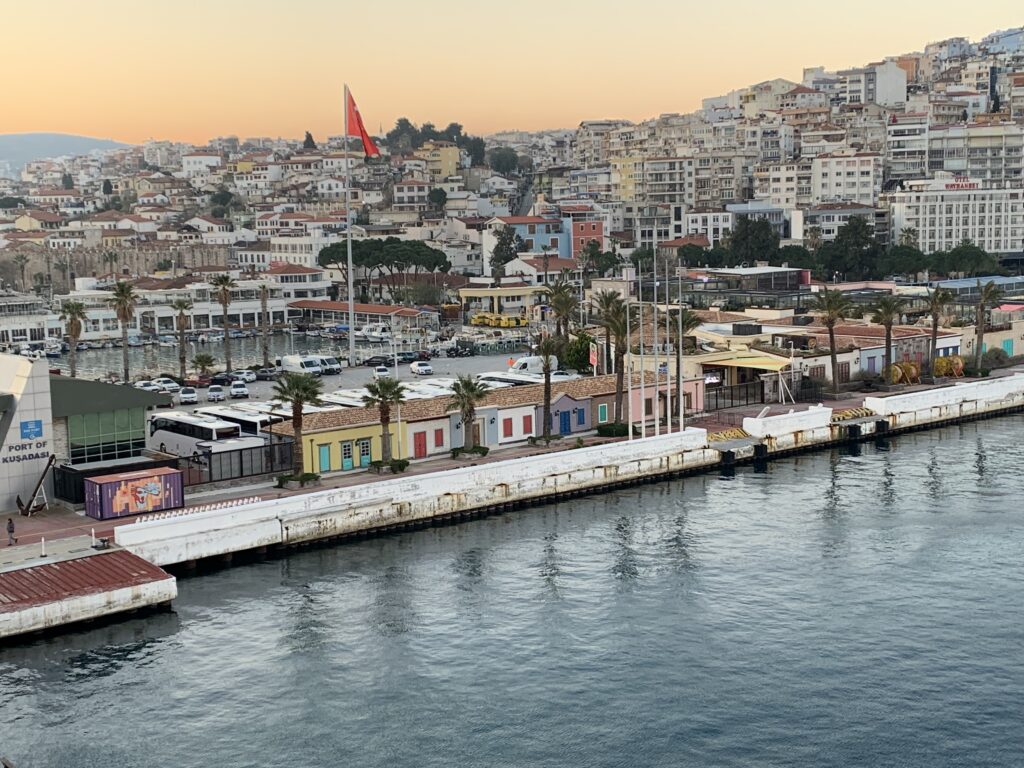
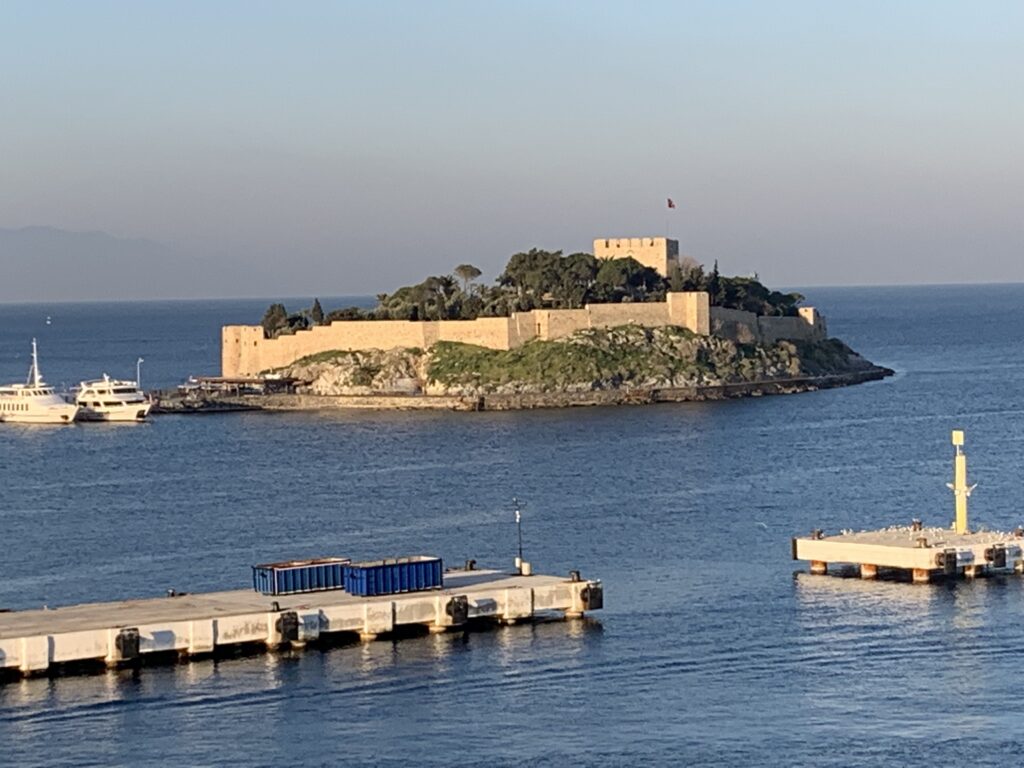
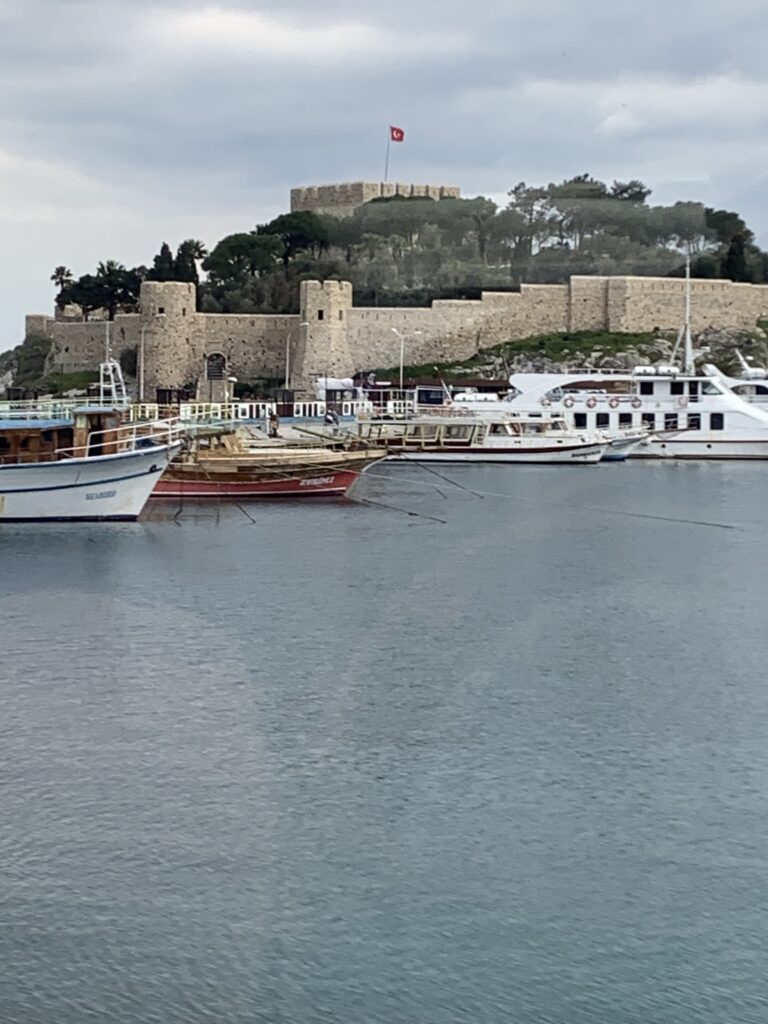
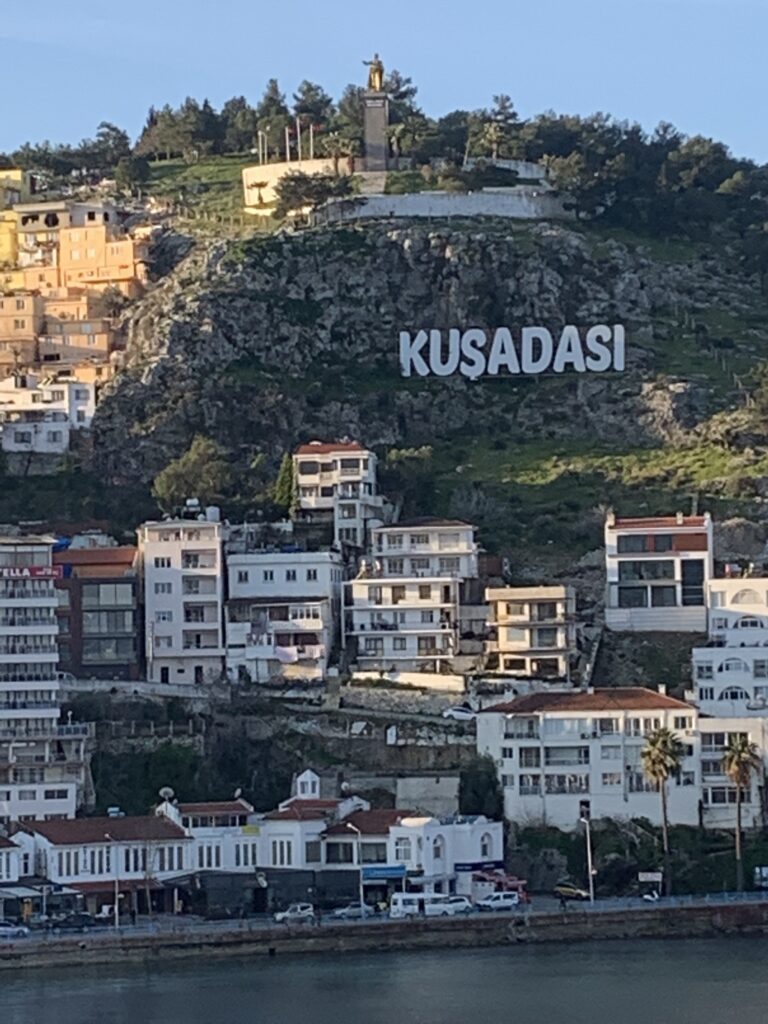
Our ship docked at Kusadasi, Turkey, a city about 18 km from the ruins of Ephesus. What caught my eye first was the Turkish Flag flying over the port. Then there was Güvercinada or Pigeon Island, a fortress built in the 16th century CE, at the end of a long causeway. The number of beautiful yachts in the harbor indicated that this was a vacation area.
In nearby Ephesus, many of the ruins have endured since it was one of the largest metropolises of the ancient world. Excavations go back to the 10th century BCE, when the city was built by Attic and Ionian Greek colonists. It is a UNESCO World Heritage Site, the center of which is the Temple of Artemis, one of the Seven Wonders of the Ancient World. Here also, St. John is said to have preached and Mary to have lived out her final days in a tiny stone house.
As we entered through a gate and walked along Harbor Street under a huge Turkish flag, we could see the ruins of the Temple of Artemis. Originally built in 550 BCE, it was destroyed and rebuilt several times. It was a major center for worship and pilgrimage. All that is left of this great Wonder of the World are the ruins of its foundations.
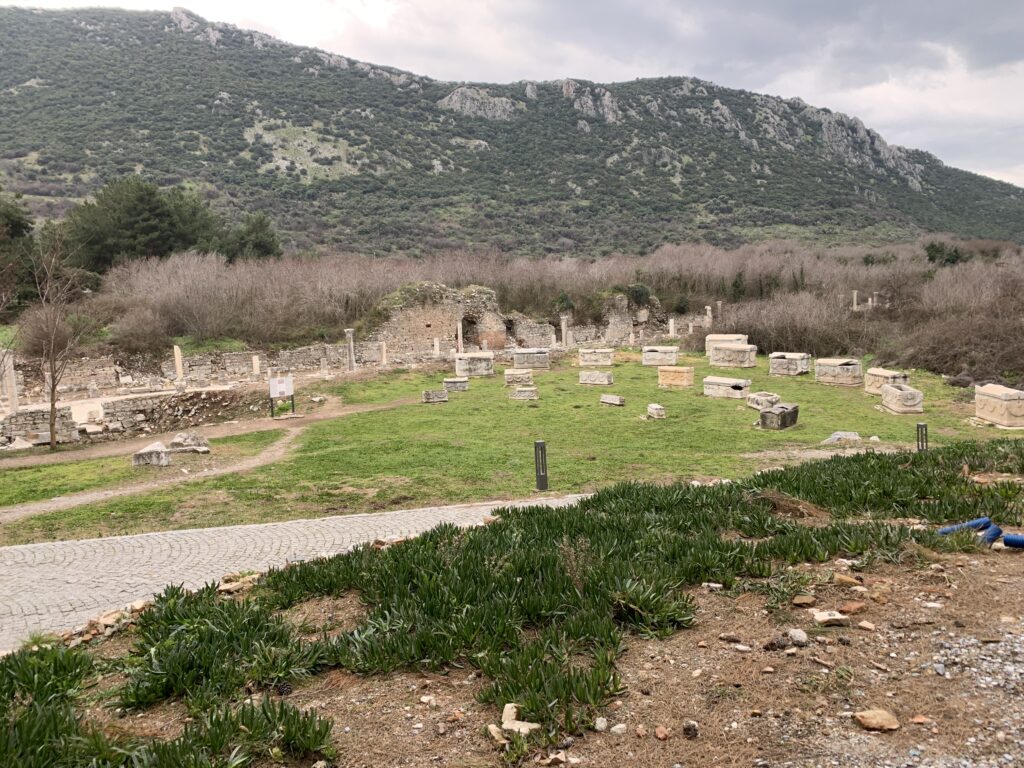
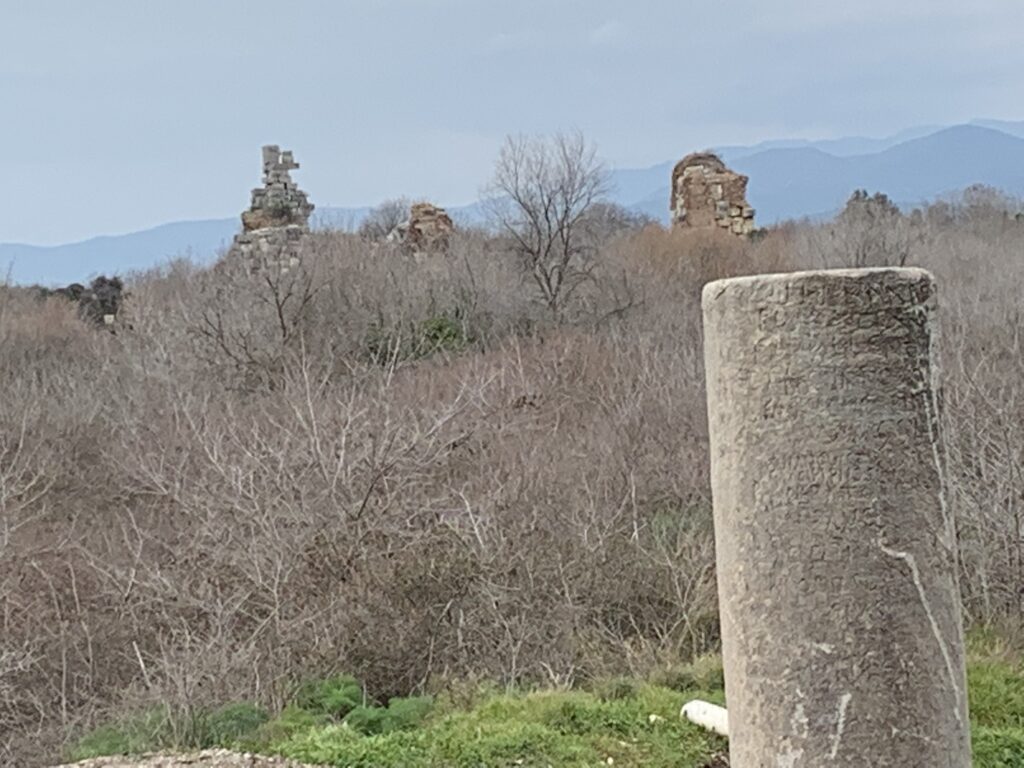
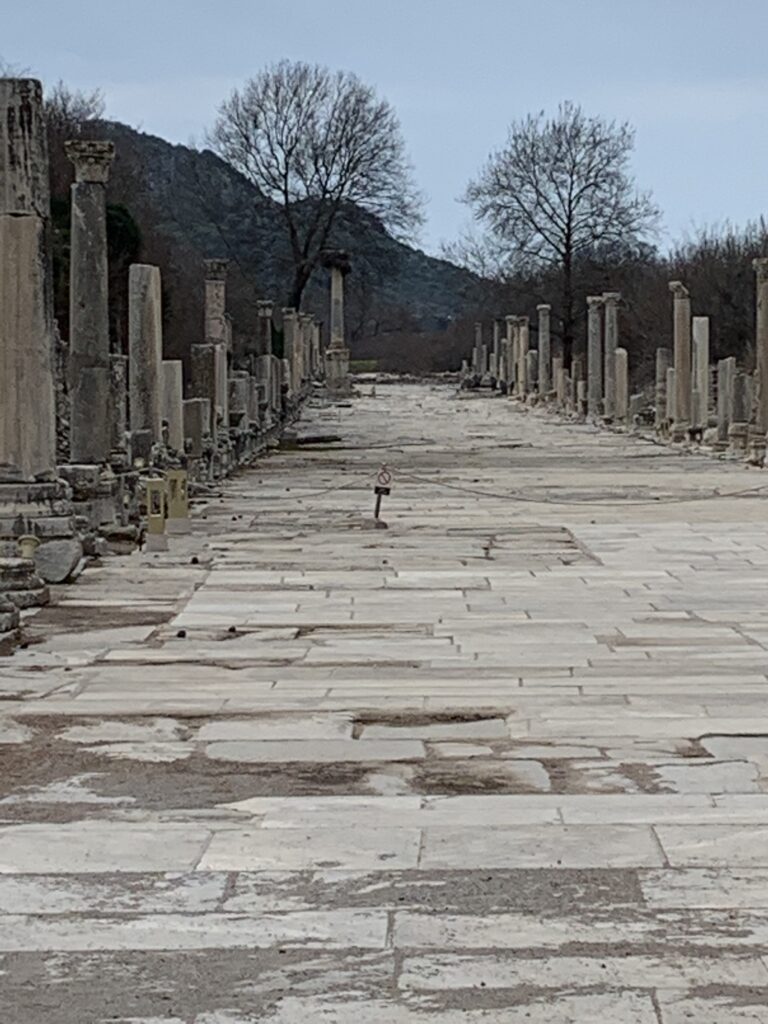
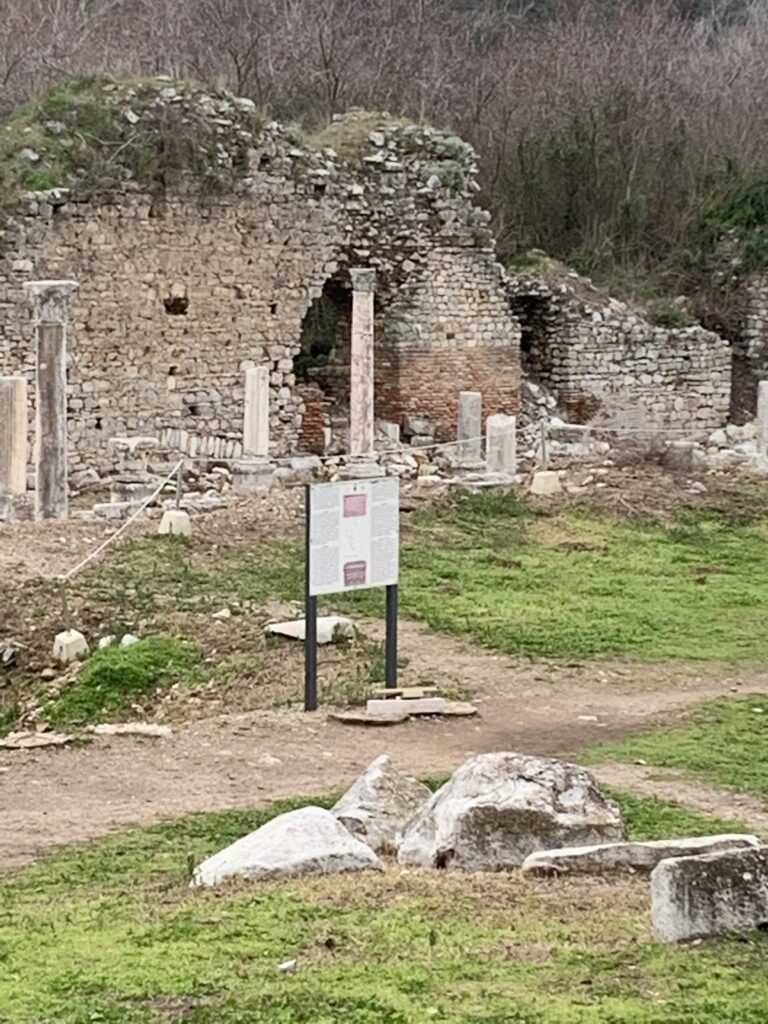
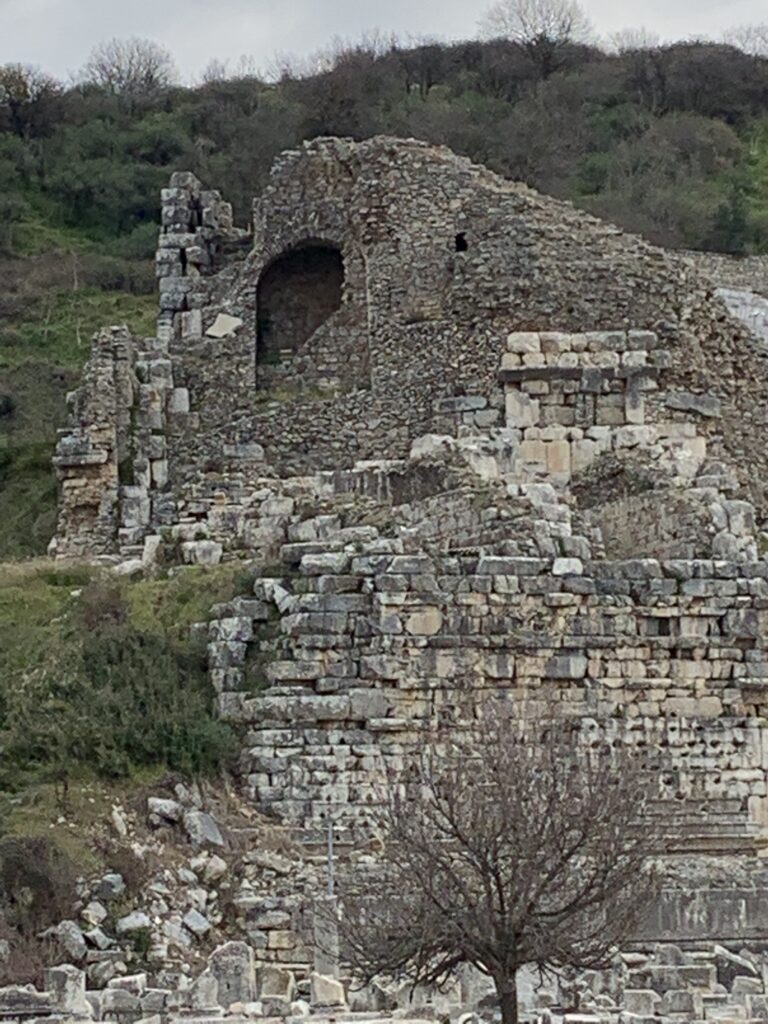
Next, we saw ruins of the gymnasium/theater on the left and Verulanus Square (the agora) on the right. The Gymnasium of Vedius, dates back to the second century CE. Dedicated to the Goddess Artemis and Emperor Antoninus Pius, it featured a palaestra, a hall of emperors with statues and mosaics, as well as a bath with different rooms like tepidarium, caldarium, and frigidarium. Across from the Gymnasium was Verulanus Square. It was also known as the Hall of Verulanus since he ordered the paving and tiling of one of the palestrae with marble slabs in 13 different shades. The spacious square served as a training ground for athletes and had a three-aisled colonnade with a middle aisle used as a running track.
Then we progressed to the well-preserved Great Theater where both St. John and St. Paul preached and more recently Elton John performed. It was one of the largest theaters in the ancient world. It can accommodate about 25,000 spectators. It was a cultural and social hub in ancient Ephesus. It is associated with the worship of Artemis.
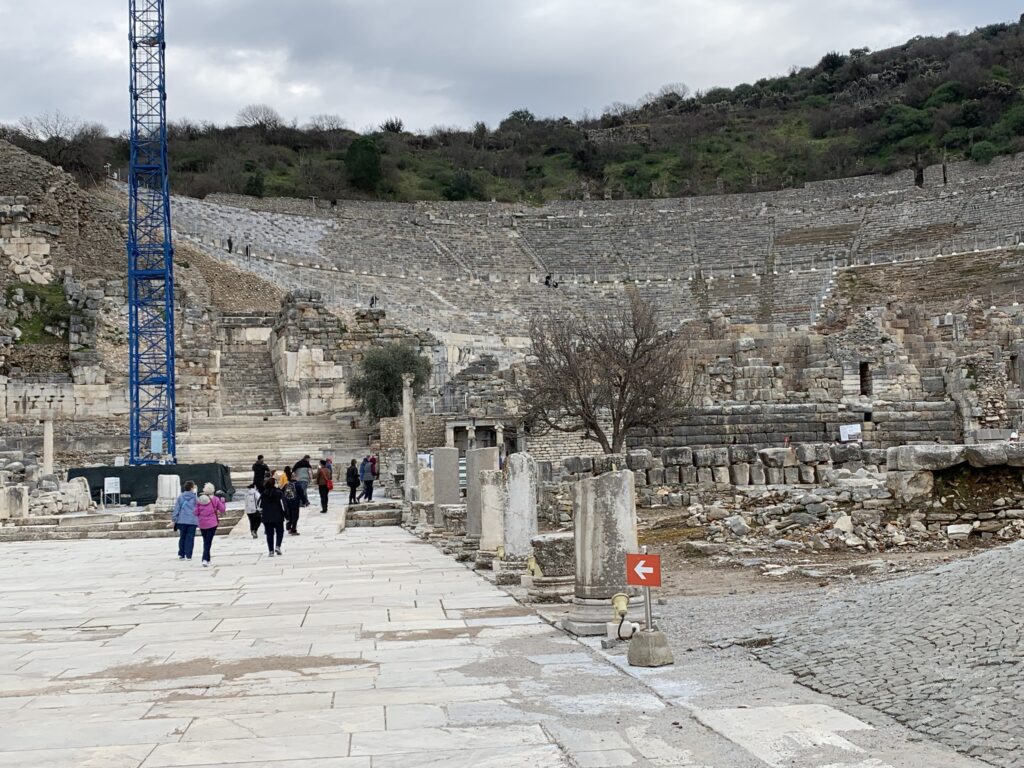
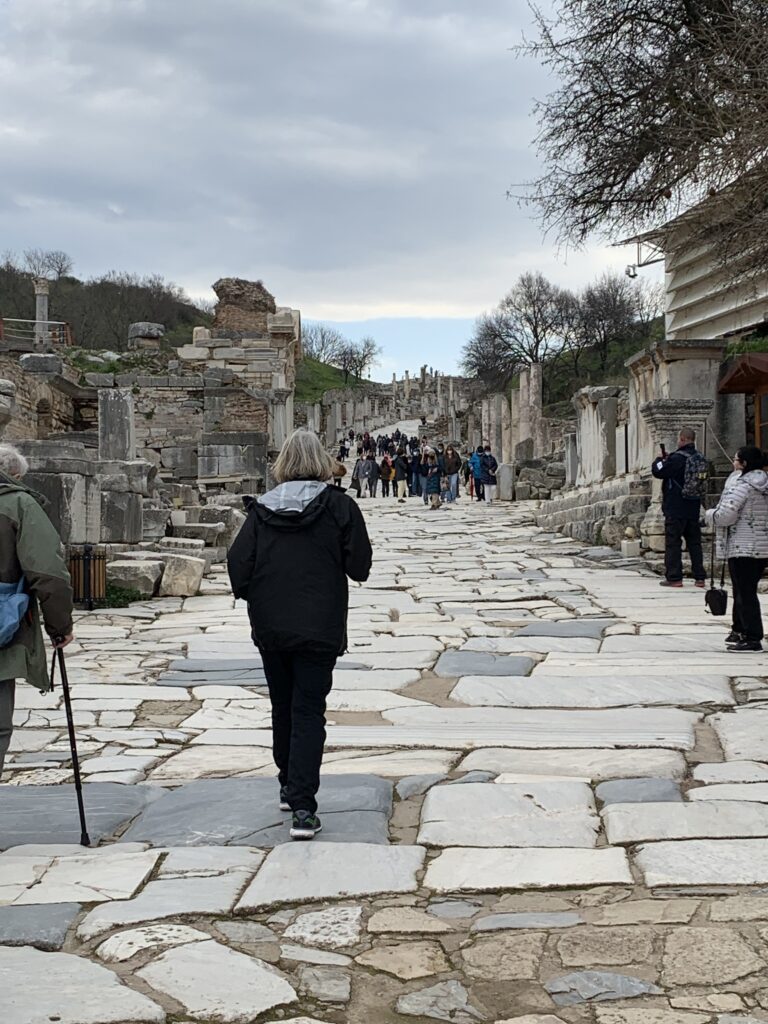
We proceeded along The Marble Road, so named because it is lined with marble columns. It overlooks the Scholastica Baths, originally built in the 1st century CE, then restored in the 4th century CE with stones brought from the Prytaneion. The restoration was funded by a Christian lady called Scholastica. Her statue still sits on the left of the eastern entrance, though the head of the statue has not yet been found.
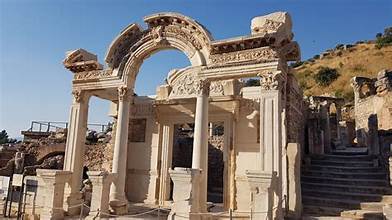
Hadrian’s Temple is one of the best-preserved and most beautiful structures on Curetes Street. It was built before 138 A.D by .Quintilius and was dedicated to Emperor Hadrian, who came to visit the city from Athens in 128 CE. The facade of the temple has four Corinthian columns supporting a curved arch, in the middle of which contains a relief of Tyche, goddess of victory. The side columns are square. The pedestal with inscriptions in front of the temple is the basis for the statues of the emperors between 293-305 CE.
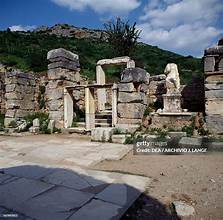
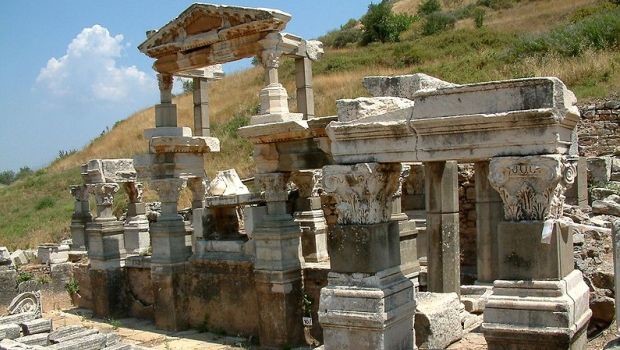
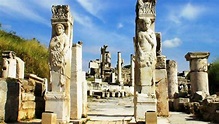
Trajan’s Fountain was built next to Hadrien’s Temple. An inscription on the fountain says it was built in the 2nd century CE and erected in honor of the Emperor Trajan. This fountain is considered one of the three most magnificent fountains of Ephesus. It had two ornamental pools, one in the front and one at the rear. The upper-level pool was surrounded with Corinthian style columns. Water flowed from a pillar on which rested a colossal statue of Emperor Trajan. We learned that Ephesians had both hot and cold running water as well as indoor plumbing.
At Curetes Street, we went to Hercules Gate, so named because it had a relief of Hercules on it. It was brought from another place in the 4th century CE, but the relief on in dates it to the 2nd century CE.
Along the way there were temples to Isis and Domitian. On the west side of the State Agora was a temple built around 29 BCE. It was thought that it was built by Marc Antony and Cleopatra to honor the Egyptian goddess, Isis. This temple was destroyed during the reign of Agustus because of his dislike of Anthony and Cleopatra. Some parts of the temple were then used in the construction of the Pollio Fountain. On the south end of Domitian Street is the Temple to Domitian. It is the first structure in Ephesus known to be dedicated to an Emperor.
The Pollio Fountain, south of the Agora, was built in 97 CE. The water was brought to Ephesus through aqueducts and distributed through baked clay pipes. Water was free to the people.
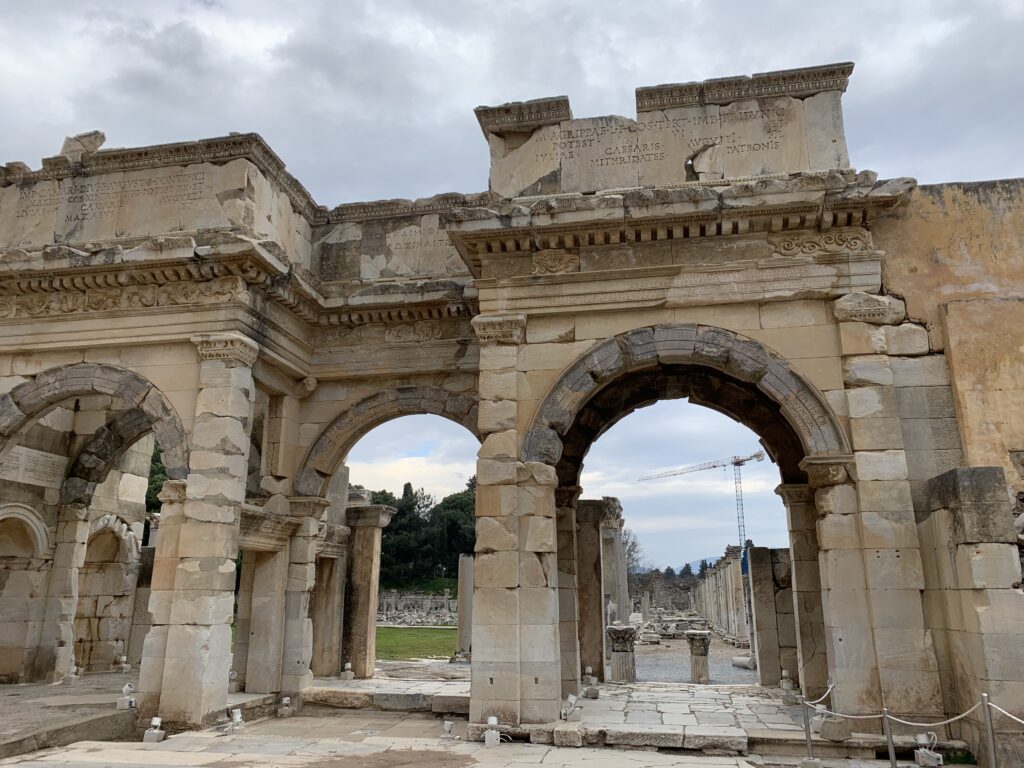
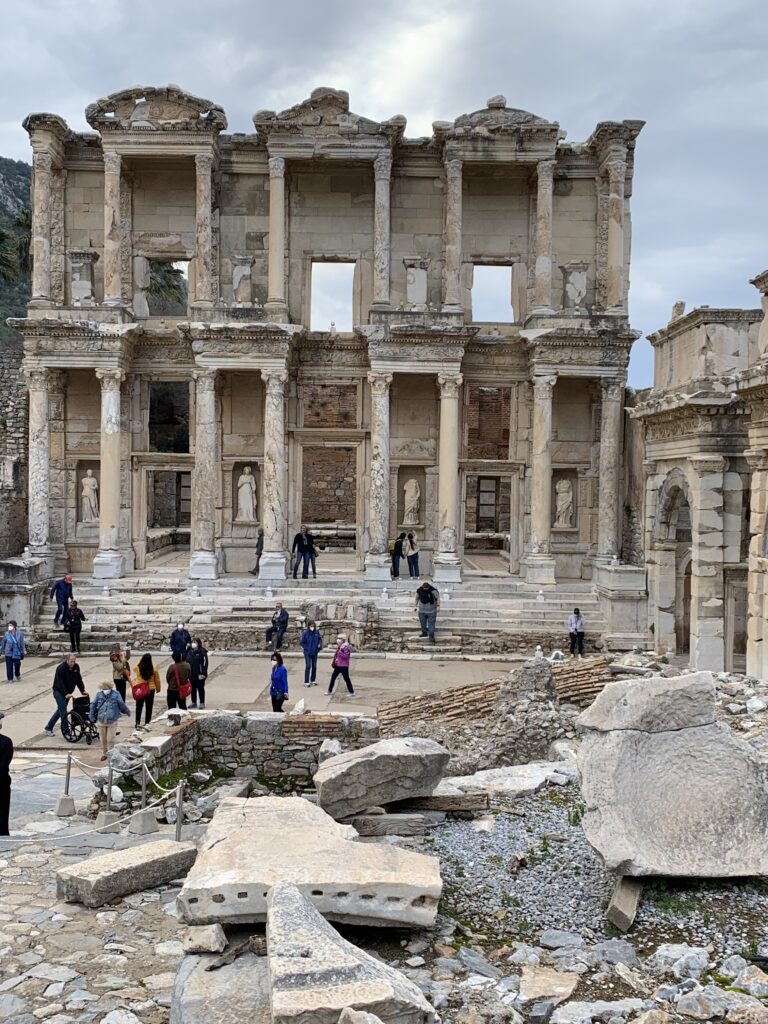
Retracing our steps, we then followed the Mosaic Paved Road back past Hadrien’s Temple to the Library of Celsus. The Library of Celsus was a tomb for Tiberius Julius Celses Polemaeanus, a Roman senator. Built about 135CE, it is the most striking building in the site. It is two stories with a marble façade. It includes intricate sculptures and 16 columns, arranged in pairs, showing a blend of Roman and Greek architectural styles. It has a staircase leading to the façade of the Library.It originally contained thousands of scrolls and was a center of scholarly activity. It was one of the largest libraries of the ancient world, second only to that in Alexandria, Egypt.
Below is a map of the archaeological site.

In addition to these sites there are two Christian sites to see. One is the Basilica of St John, which was built over the tomb of St John the Apostle. according to tradition, St. John spent his last days in Ephesus, where preached and wrote his gospel. The basilica was a major pilgrimage site in the Middle Ages and remains an important spiritual destination today. Though mostly ruins, the tomb, along with some pillars and mosaic fragments are still visible.
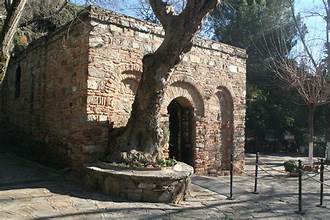
Located on Mount Koressos, the House of the Virgin Mary is believed to be the place where Mary, the mother of Jesus, spent her final days. According to tradition, St. John brought Mary to Ephesus after the crucifixion, and she lived in this quiet house until her Assumption. This site is a popular pilgrimage destination for both Christians and Muslims, who revere Mary as a holy figure. In addition to the house, there is a small chapel, altar and wishing wall.
The Cave of Saint Paul stands on the southern side of ancient Ephesus. The cave has been a sacred site from the early Christian era until the late 19th century. The cave is decorated with numerous iearly Christian frescoes and inscriptions depicting figures like the Virgin Mary, St. Paul, and St. Thecla. It was discovered in 1892 by a group of priests searching for the tomb of the Blessed Virgin Mary.
Next will be Rhodes.
Leave a Reply